
Last updated: October 21, 2026
Quick Answer
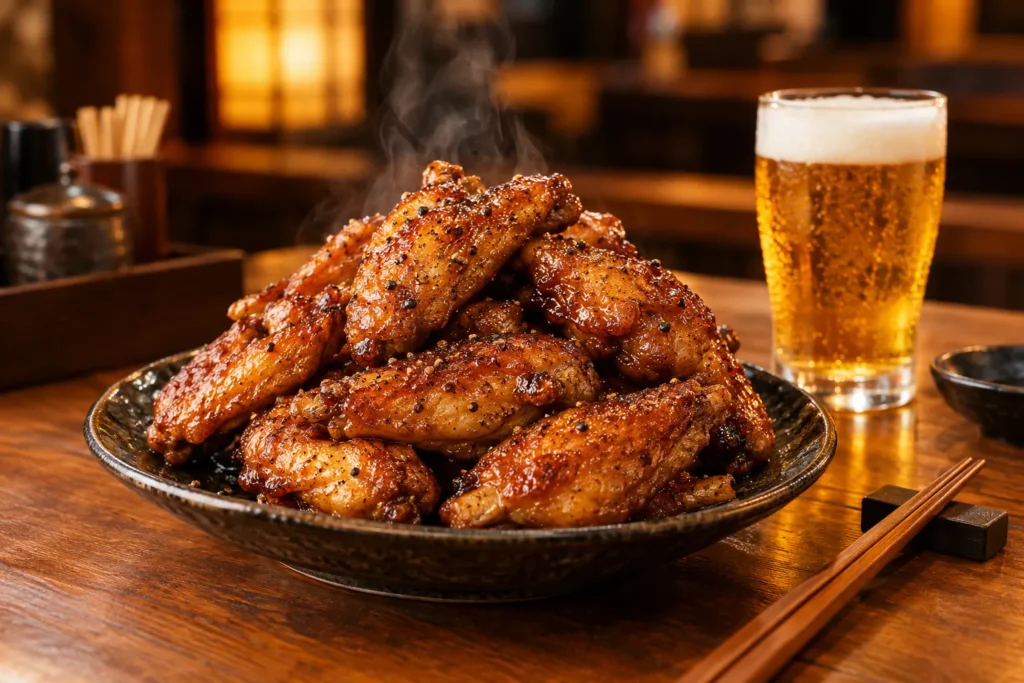
Japanese Chicken Wings, known in their home region as tebasaki, are double-fried chicken wings coated in a sweet-savory soy glaze and finished with a heavy dusting of black pepper. The style was invented in Nagoya in the 1960s at the restaurant Furaibo and remains one of Japan’s most recognized bar foods. The defining traits are a shatter-crisp, non-greasy skin and a bold pepper-forward glaze, achieved through a two-stage frying process rather than batter or breading.
Key Takeaways
- Japanese Chicken Wings, or tebasaki, originated at Furaibo in Nagoya in the 1960s and are now a defining regional specialty.
- The signature texture comes from double-frying: an initial fry to cook the meat, then a second, hotter fry for crisp skin.
- The classic glaze is soy sauce, sugar or mirin, and garlic, finished with coarsely cracked black pepper.
- Major chains such as Sekai no Yamachan and Furaibo have built national reputations around their versions of the dish.
- The annual Tebasaki Summit in Nagoya, held June 5-7, 2026, gathers roughly 20 wing shops and expects about 150,000 visitors.
- Japanese wings differ from Korean wings mainly in sauce profile: soy-pepper glaze versus gochujang-based sweet-spicy coatings.
- Thai-style wings lean on fish sauce, lime, and chili rather than Japan’s soy-mirin-pepper combination.
- Gluten-free versions are achievable by swapping wheat soy sauce and wheat starch for tamari and rice flour or potato starch.
- Tebasaki are traditionally izakaya food, meant to be eaten with beer rather than as a standalone entree.
- The dish has crossed into fast food, appearing in McDonald’s Japan’s regional menu and inside ramen bowls at chains like Jinya Ramen Bar.
What exactly are Japanese chicken wings
Japanese Chicken Wings are a style of fried chicken wing, most famously Nagoya’s tebasaki, defined by a double-fried crispy skin and a glossy soy-based glaze finished with black pepper. They are not breaded or battered the way American wings often are. Instead, the skin crisps through frying technique alone, then absorbs a thin, sticky sauce.

Within Japanese cuisine, tebasaki sits as a sub-style of the broader yakitori and kushiyaki (grilled skewer) family, though tebasaki is fried rather than grilled. The wing is usually left whole or split at the joint, with bone in, and served unsauced on the inside so the meat stays juicy while the skin stays dry and crackly. Expect a wing that is sticky on the outside, tender underneath, and carries a sharp pepper aroma with the first bite.
How do you make crispy Japanese chicken wings at home
Crispy Japanese Chicken Wings at home come down to one technique: frying the wings twice, with a rest in between. Skip the rest step and the skin will steam instead of crisp.
Follow this sequence for best results:
- Pat wings completely dry and season lightly with salt.
- Dust wings in a thin coat of potato starch or cornstarch, shaking off excess.
- Fry at a moderate 325°F until the meat is cooked through but the skin is still pale, about 8 minutes.
- Rest the wings on a wire rack for 10 minutes. This step lets residual moisture escape.
- Fry a second time at 375°F for 3 to 4 minutes until deep golden and audibly crisp.
- Toss immediately in warm glaze while the skin is still hot, so the sauce clings without soaking in.
Choose a neutral oil with a high smoke point, such as rice bran or vegetable oil, since it won’t compete with the pepper and soy flavors.
Best Japanese chicken wing recipe
The best Japanese Chicken Wings recipe balances four things: a dry, starch-dusted skin, a true double fry, a glaze built on soy sauce and sugar, and a finish of coarsely cracked black pepper added off heat. Recipes that skip the rest between fries or use fine white pepper instead of cracked black pepper will taste close, but not authentic.
Recipe Subtitle
Crispy double-fried Nagoya-style wings glazed in sweet soy and finished with cracked black pepper.
Recipe Description
This recipe recreates Nagoya’s signature tebasaki: chicken wings fried twice for a dry, crackling skin, then tossed in a glossy soy-garlic glaze and dusted heavily with black pepper. It is built for sharing with cold drinks and comes together in under an hour, making it a practical centerpiece for casual entertaining or a weeknight treat with an izakaya feel.
Recipe Keywords
Japanese chicken wings, tebasaki recipe, Nagoya wings, double fried chicken wings, soy glazed wings, Japanese izakaya food, crispy chicken wings
Difficulty Level
Intermediate
Preparation Time
20 minutes
Cooking Time
20 minutes
Rest Time
10 minutes
Cooking Temperature (Fahrenheit)
325°F first fry, 375°F second fry
Calories
Approximately 320 per serving (4 wings)
Best Season
Year-round; especially popular in summer alongside cold beer
Cooking Methods
Double frying, glazing, pan reduction, seasoning
Cuisines Suggestions
Japanese, Pan-Asian, izakaya bar food
Recipe Badges
Dairy-Free, High-Protein, Shareable Appetizer
Recipe Keys
Double-frying is non-negotiable for true tebasaki crispness. Glaze goes on after frying, never before. Cracked black pepper should be added last, off the heat, to preserve its aroma.
Ingredients
- 2 lbs chicken wings, split at the joint
- 1/2 cup potato starch
- 1/2 cup soy sauce
- 1/4 cup sugar
- 2 tbsp mirin
- 2 cloves garlic, grated
- 1 tbsp sesame seeds (optional)
- 2 tsp coarsely cracked black pepper
- Neutral frying oil, as needed
- Salt, to taste
Instructions
- Pat wings dry and season lightly with salt.
- Coat wings in potato starch, shaking off excess.
- Fry at 325°F for 8 minutes, then rest on a wire rack for 10 minutes.
- Meanwhile, simmer soy sauce, sugar, mirin, and garlic in a saucepan until slightly thickened, about 5 minutes.
- Fry wings a second time at 375°F for 3 to 4 minutes until deeply golden and crisp.
- Toss hot wings in the warm glaze until evenly coated.
- Sprinkle generously with cracked black pepper and sesame seeds, then serve immediately.
Equipment
Deep fryer or heavy pot for frying, wire cooling rack, instant-read thermometer, small saucepan, tongs
Nutrition
| Nutrient | Per Serving (4 wings) |
|---|---|
| Calories | 320 kcal |
| Protein | 22 g |
| Fat | 21 g |
| Carbohydrates | 12 g |
Notes
Rest the wings between fries without skipping this step, or the skin will turn rubbery instead of crisp. Use coarsely ground pepper, not fine powder, for the proper textural bite. Make the glaze slightly thinner than you think you need, since it thickens quickly on contact with hot wings.
What’s the difference between Japanese and Korean chicken wings
Japanese Chicken Wings rely on a soy-sugar glaze finished with black pepper, while Korean wings typically use a gochujang-based sauce that is sweet, spicy, and often stickier with a red hue. Both styles use double frying for crispness, but the flavor direction diverges sharply.
- Japanese tebasaki: soy sauce, sugar or mirin, garlic, cracked black pepper; savory with mild sweetness.
- Korean fried wings: gochujang or gochugaru, garlic, ginger, sometimes honey; sweet-spicy with visible red glaze and sesame seeds.
- Texture goal is similar in both: dry, crackling skin from a two-stage fry.
Choose Japanese-style wings if the goal is a savory, pepper-forward flavor paired with beer. Choose Korean-style wings for a sweeter, chili-forward profile.
Japanese chicken wings marinade: how to do it
A proper Japanese Chicken Wings marinade is less about a long soak and more about a quick toss after frying, since the glaze is applied post-fry rather than before. A short pre-fry seasoning with salt and sometimes a touch of sake helps the meat, while the real flavor lands in the post-fry glaze.
Standard glaze ratio: equal parts soy sauce and sugar, a splash of mirin for shine, grated garlic, and a generous amount of coarsely cracked black pepper stirred in at the very end. Simmer the base gently until it coats the back of a spoon, then toss the just-fried wings in it while both are hot. Avoid marinating raw wings in soy sauce for hours beforehand; the sugar content can cause excessive browning or burning during frying.
How long do you cook Japanese chicken wings
Japanese Chicken Wings need roughly 11 to 12 minutes of total active frying time across two stages, plus a 10-minute rest between fries. The first fry at 325°F takes about 8 minutes to cook the meat through; the second fry at 375°F takes 3 to 4 minutes to crisp the skin.
Internal temperature should reach 165°F by the end of the first fry. Skipping the rest period is the most common timing mistake, since it causes trapped steam to soften the skin during the second fry.
What sauce goes on Japanese chicken wings
The standard sauce on Japanese Chicken Wings is a reduced mixture of soy sauce, sugar, mirin, and garlic, applied hot and finished with cracked black pepper. Some shops, including Sekai no Yamachan, use a proprietary “phantom pepper” blend that adds extra heat and aroma beyond standard black pepper.
Variations exist, including a touch of rice vinegar for brightness or a dash of chili oil for shops aiming at a spicier profile, but the soy-sugar-pepper base remains constant across nearly all authentic versions.
Where can I get authentic Japanese chicken wings near me
Authentic Japanese Chicken Wings are most reliably found at Japanese izakaya restaurants, particularly any location of Nagoya-based chains such as Furaibo or Sekai no Yamachan, which have expanded into other Japanese cities and some international markets. Searching for “tebasaki” alongside “izakaya” in a local directory is more effective than searching generic “chicken wings,” since many Western wing restaurants do not use the Japanese technique.
- Look for menus specifically naming “tebasaki” rather than generic “karaage wings.”
- Chains with Nagoya roots are the most reliable source outside Japan.
- Independent izakaya in cities with large Japanese communities often carry a house version.
Japanese chicken wing restaurants near me: what to look for
The most dependable Japanese Chicken Wing restaurants are those built around the Nagoya tebasaki tradition, since the dish is regionally specific rather than universal across Japan. Furaibo, the originator, and Sekai no Yamachan, known for its “Maboroshi no Tebasaki” (phantom wings), are the two most recognized names and both maintain multiple locations.
Decision rule: choose a restaurant if its menu explicitly references Nagoya or tebasaki; skip restaurants that only list generic “Japanese fried chicken,” since that likely means karaage (boneless fried chicken chunks) rather than true wing-based tebasaki.
How do restaurants get the skin so crispy
Restaurants achieve crispy skin on Japanese Chicken Wings through the double-fry method combined with a dry starch coating and careful oil temperature control. The first fry cooks the interior gently; the rest period lets surface moisture evaporate; the second, hotter fry dehydrates and crisps the exterior.
Commercial kitchens also benefit from high-volume fryers that maintain stable oil temperature better than most home stovetops, which is part of why restaurant wings often crisp more evenly than home versions. Using a thermometer at home closes most of that gap.
Can you make Japanese chicken wings gluten free
Yes, Japanese Chicken Wings can be made gluten free by substituting tamari for standard soy sauce and using potato starch or rice flour instead of wheat-based coatings. Since the dish traditionally relies on starch dusting rather than breadcrumbs, it is naturally easier to adapt than battered Western-style wings.
Check that mirin and any packaged glaze mixes are labeled gluten free, since some contain wheat-derived alcohol. Double-check fryer oil has not been used for breaded, gluten-containing foods if cross-contact is a concern.
Common mistakes people make with Japanese chicken wings
The most common mistake with Japanese Chicken Wings is skipping the rest period between fries, which prevents the skin from reaching true crispness. A close second is glazing the wings before frying instead of after, which causes burning due to the sugar content.
- Frying only once instead of twice.
- Using fine white pepper instead of coarsely cracked black pepper, losing the signature aroma.
- Overcrowding the fryer, which drops oil temperature and causes soggy skin.
- Applying glaze too early, scorching the sugar before the skin crisps.
- Not drying the wings before starching, leading to uneven coating.
Japanese chicken wings vs Thai wings: what’s different
Japanese Chicken Wings use a soy-sugar-pepper glaze, while Thai-style wings typically rely on fish sauce, lime juice, garlic, and chili for a brighter, more acidic and spicy profile. Both styles favor crispy, non-battered skin, but the seasoning direction is distinct.
- Japanese: soy, sugar, mirin, black pepper; savory-sweet.
- Thai: fish sauce, lime, chili, garlic; sour-spicy-salty.
Choose Japanese-style wings for a milder, savory beer-pairing snack. Choose Thai-style wings if a sharper, spicier, citrus-forward flavor is the goal.
Are Japanese chicken wings healthy
Japanese Chicken Wings are a moderate-calorie, high-protein food best treated as an occasional indulgence rather than a daily staple, since the double-fry method and sugar-based glaze add meaningful fat and sugar content per serving. A typical four-wing serving runs around 320 calories with roughly 21 grams of fat.
They are not inherently unhealthy in moderation, especially compared to heavily battered fried chicken, since the coating is a thin starch dusting rather than a thick batter. Portion control and pairing with vegetables or a lighter side dish help balance a meal built around tebasaki.
FAQs
What does tebasaki mean in Japanese? Tebasaki refers specifically to the chicken wing (literally “hand tip”), and in culinary use it has become shorthand for Nagoya’s double-fried, soy-glazed wing style.
Is karaage the same as tebasaki? No. Karaage is typically boneless, bite-sized fried chicken pieces, while tebasaki refers to whole or split bone-in wings fried and glazed in the Nagoya style.
Why is black pepper so important in Japanese chicken wings? Black pepper provides the signature aromatic finish that distinguishes tebasaki from other fried wing styles, and it is traditionally added coarsely cracked and off heat to preserve its sharpness.
Can Japanese chicken wings be baked instead of fried? Baking can approximate the flavor but will not fully replicate the dry, shattering crispness that comes from a true double fry in hot oil.
What drink pairs best with Japanese chicken wings? Cold Japanese lager is the traditional pairing, chosen for its carbonation and crispness that cuts through the glaze’s sweetness and the fried skin’s richness.
Are Japanese chicken wings spicy? Standard tebasaki is not spicy; it is savory and peppery rather than hot. Some shops offer spicier variants using chili oil or extra pepper blends for customers who want heat.
Conclusion
Japanese Chicken Wings earned their reputation through a simple but exacting method: dry the skin, fry it twice, and finish it with a soy-sugar glaze and a generous hit of cracked black pepper. The dish traces directly back to Furaibo in 1960s Nagoya and has since grown into a national and increasingly international favorite, celebrated each year at events like Nagoya’s Tebasaki Summit. For home cooks, the path to an authentic result is straightforward: commit to the double fry, don’t skip the rest between fries, and glaze only after the skin has crisped. Start with the recipe above, adjust pepper intensity to taste, and serve with a cold beer for the full izakaya experience.
Meta Title: Japanese Chicken Wings: Origins, Recipe, and Crispy Tebasaki Guide Meta Description: Learn what Japanese chicken wings (tebasaki) are, how to make them crispy at home, and how they compare to Korean and Thai wing styles.