Last updated: October 18, 2026
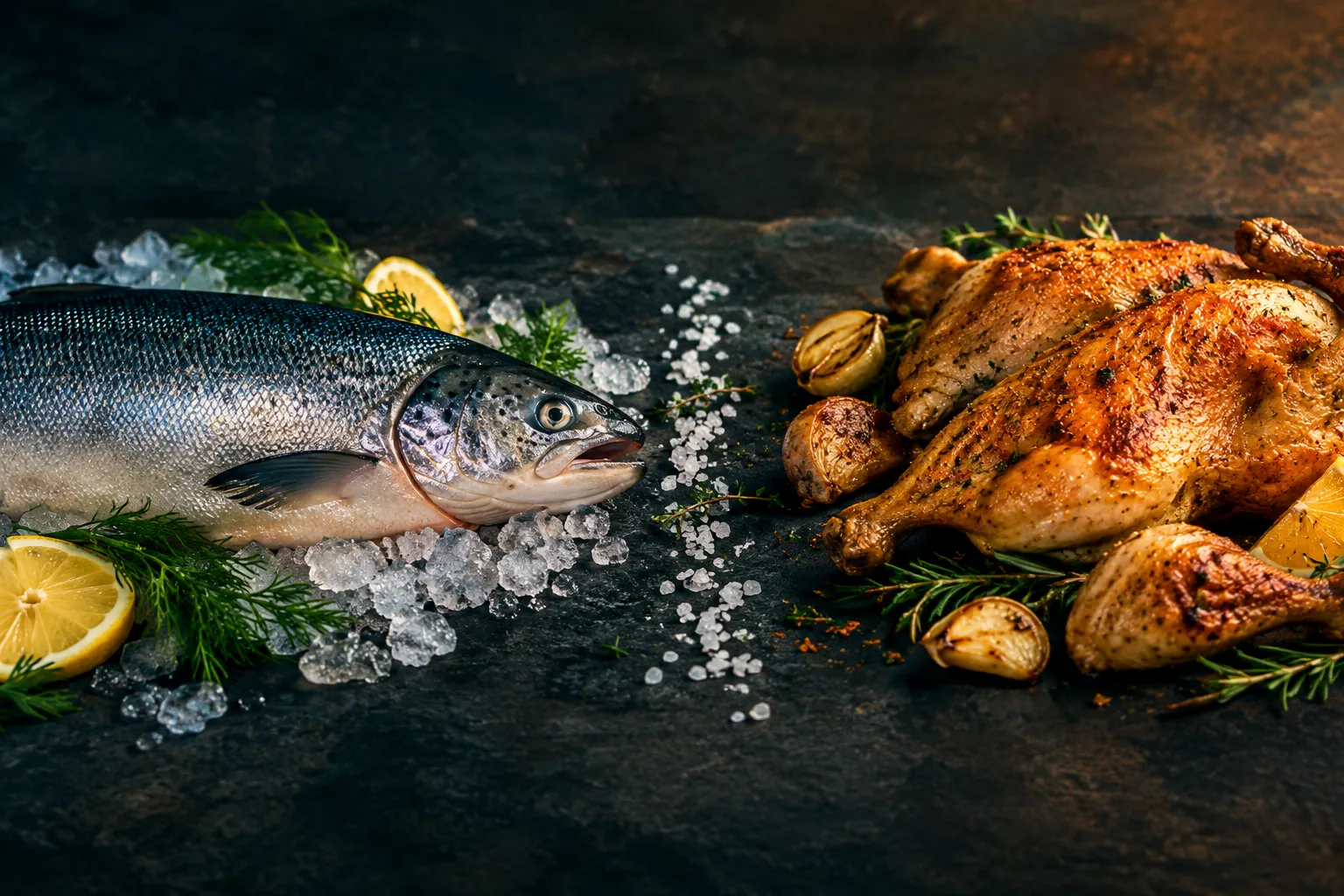
Quick Answer: Salmon fed with chicken refers to farmed salmon whose feed contains poultry byproducts, such as chicken meal or chicken hydrolysate, as a protein substitute for traditional fishmeal. Major producers including Mowi, Lerøy, and SalMar have adopted this practice. Regulatory bodies in Europe and North America consider it safe for human consumption, though consumer concerns about transparency and labelling remain significant in 2026.
Key Takeaways
- Major Norwegian and Scottish salmon farmers now include poultry byproducts in salmon feed, a shift confirmed by industry reporting in 2026.
- Chicken meal and chicken hydrolysate are the most common poultry-derived ingredients used in salmon feed formulations.
- Food safety authorities have not identified health risks from eating salmon fed with chicken-based ingredients.
- Farmed salmon fed chicken-based diets can still deliver omega-3 fatty acids, though the ratio may shift depending on total feed composition.
- Consumer research shows many people find the practice “unnatural,” yet labelling requirements in most markets do not require disclosure.
- Wild-caught salmon eat crustaceans, smaller fish, and zooplankton, making chicken-based feed a significant departure from nature’s diet.
- Sustainable aquaculture researchers at institutions such as NMBU are studying avian protein integration as a long-term feed solution.
- Scottish salmon farmers and Canadian seafood producers have faced public scrutiny over the practice, even as some deny using poultry byproducts.
What Does It Mean When Salmon Is Fed Chicken?
Salmon fed with chicken means that farmed Atlantic salmon receive feed pellets containing processed poultry ingredients, most commonly chicken meal or chicken hydrolysate, instead of relying solely on marine-sourced fishmeal. This shift is driven by the limited global supply of wild-caught fish used for feed production and the need to find cost-effective, scalable protein alternatives. According to reporting covered by Salmon Business, Mowi, Lerøy, and SalMar have all turned to chicken byproducts for salmon feed.
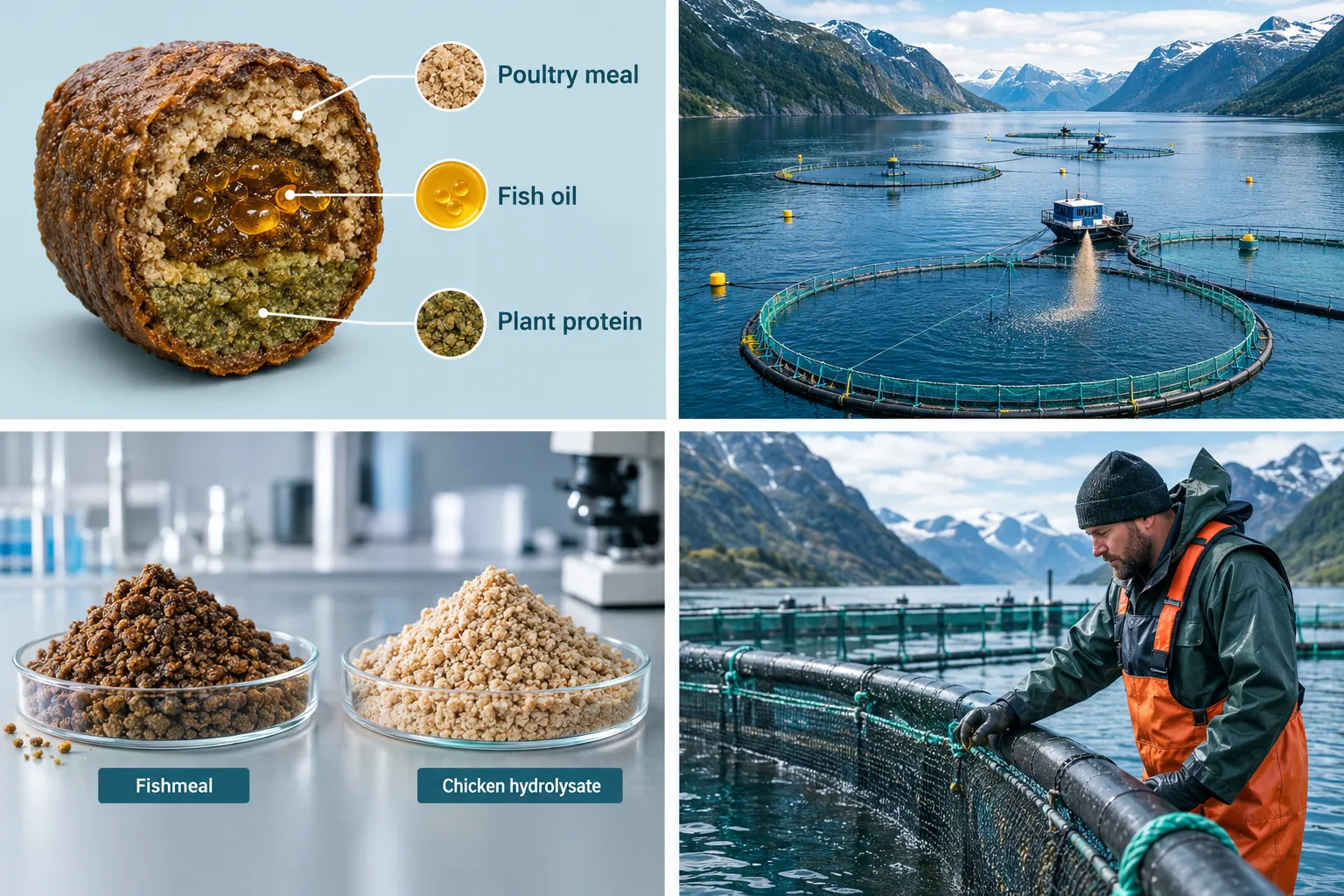
Poultry byproducts used in salmon feed include:
- Chicken meal: Rendered and dried chicken tissue, including offcuts not used in human food production.
- Chicken hydrolysate: A liquid or powder produced by enzymatic breakdown of chicken protein, offering high digestibility for fish.
- Feather meal: Processed poultry feathers hydrolyzed into a protein-dense ingredient.
The term “salmon fed with chicken” does not mean whole chicken pieces are dropped into fish pens. Feed manufacturers blend these ingredients into compressed pellets. The salmon eat those pellets just as they would any other formulated feed. Research into integrating avian protein products into salmon feed practices is ongoing, with projects documented by Sustainable Aquaculture.
Why Would Salmon Be Fed Chicken Instead of Fish?
The core reason is supply pressure on marine ingredients. Global fishmeal production has plateaued, and the aquaculture industry’s demand for feed protein continues to grow. Chicken-based proteins offer a terrestrial, scalable alternative that reduces dependence on wild-caught forage fish.
Key drivers behind the shift include:
- Cost: Chicken meal is often cheaper per kilogram of protein than fishmeal, particularly when forage fish prices spike.
- Availability: Poultry processing generates large volumes of byproduct material that would otherwise go to waste.
- Sustainability targets: Reducing the fish-in, fish-out ratio is a core metric for aquaculture sustainability certification schemes.
- Research support: Studies published in peer-reviewed journals, including work accessible via Wiley Online Library, have examined how salmon digest and perform on avian protein diets.
Norway has been expanding its incentive scheme for lower-impact fish farming, which creates financial pressure on producers to reduce marine ingredient use. Canada’s seafood farming sector has also hailed progress in sustainable salmon feed formulations that move away from wild-caught fish. The Ground News summary confirms European salmon producers have formally begun feeding fish chicken meat as part of this broader trend.
Is It Safe to Eat Salmon That Was Fed Chicken?
Yes, current scientific consensus and food safety assessments indicate that eating salmon fed with chicken-based ingredients poses no identified health risk to consumers. Regulatory bodies in the EU, UK, and North America have reviewed poultry byproduct use in aquaculture feed and have not issued prohibitions on the practice for food-producing fish.
Several points support this conclusion:
- Chicken meal and chicken hydrolysate are fully processed at high temperatures, eliminating pathogen risk before they enter feed.
- The salmon’s own digestive and metabolic processes further transform dietary inputs before they reach edible muscle tissue.
- No peer-reviewed study to date has demonstrated a measurable food safety hazard in the flesh of salmon that consumed poultry-derived feed ingredients.
- The Seafood Media search brief notes ongoing industry and regulatory attention to feed transparency.
One legitimate nutritional consideration is omega-3 content. Salmon naturally accumulate EPA and DHA from marine-based diets. When feed contains more terrestrial protein and less fish oil, the omega-3 profile of the flesh can shift. Consumers who eat salmon specifically for omega-3 benefits should check whether farmed salmon products meet minimum omega-3 thresholds, which vary by certification body.
What Do Salmon Normally Eat vs. Chicken-Based Feed?
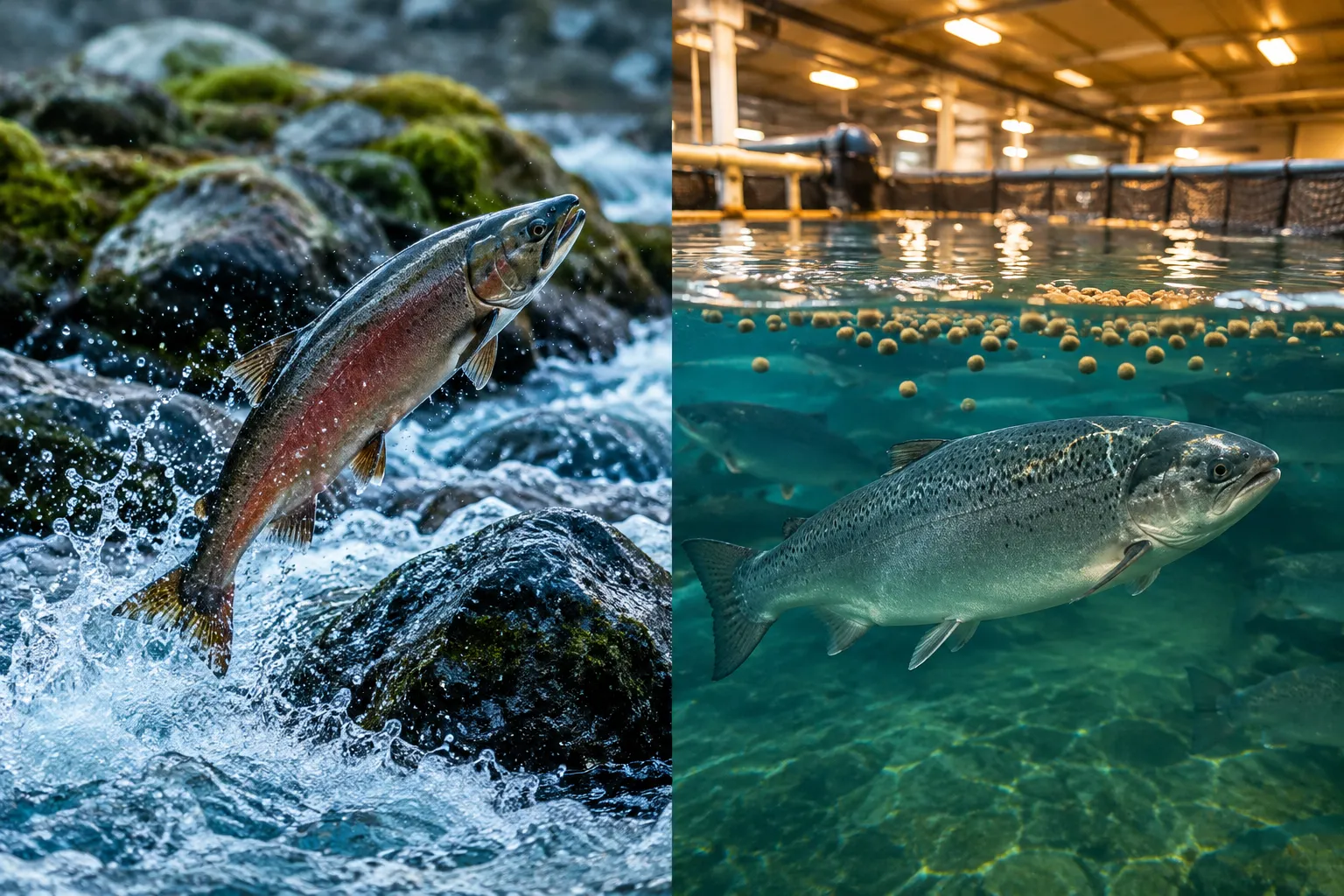
In nature, wild salmon eat a diet of smaller fish, crustaceans, krill, squid, and zooplankton. This marine-based food chain is what gives wild salmon their characteristic pink color, from astaxanthin in krill and shrimp, and their high omega-3 content. Farmed salmon fed chicken-based diets receive a diet that diverges significantly from what nature intended.
| Diet Component | Wild Salmon | Farmed Salmon (Chicken-Based Feed) |
|---|---|---|
| Primary protein source | Forage fish, crustaceans | Chicken meal, soy, fishmeal blend |
| Omega-3 source | Marine food chain | Fish oil (added), reduced proportion |
| Astaxanthin source | Krill, shrimp | Synthetic astaxanthin added to feed |
| Feed environment | Open ocean, rivers | Aquaculture pens, controlled feed |
Salmon are carnivores by nature, and their digestive systems are well-adapted to high-protein animal diets. Research shows they can utilize chicken-derived protein efficiently, though the amino acid profile differs from marine sources. The latest findings from NMBU (Norwegian University of Life Sciences) on sustainable feed research support continued investigation into how avian proteins affect salmon trout and Atlantic salmon growth rates and health markers.
How Can You Tell If Salmon Was Fed Chicken?
Currently, there is no straightforward way for consumers to tell from standard product labelling whether a salmon was fed chicken-based ingredients. Most markets, including the UK, EU, and the US, do not require feed ingredient disclosure on retail salmon packaging.
Steps consumers can take:
- Check certification labels: Some sustainability certifications require feed ingredient transparency. Ask suppliers about their feed sourcing policies.
- Search brand websites: Some producers publish feed composition data. Don’t assume silence means no chicken ingredients are used.
- Contact retailers directly: Several UK supermarkets have faced questions about whether their farmed salmon suppliers use poultry byproducts, with replies from retailers varying in detail.
- Look for wild-caught labelling: Wild-caught salmon, by definition, does not receive any formulated feed.
The Head Topics summary reported that salmon fed chicken byproducts may reach UK supermarkets, highlighting the gap between industry practice and consumer awareness. Transparency advocates argue that without clear labelling, consumers simply don’t know what they’re buying.
Does Salmon Fed Chicken Taste Different from Wild-Caught Salmon?
The taste difference between salmon fed chicken-based diets and wild-caught salmon is real but subtle for most consumers. Wild salmon typically have a firmer texture, deeper color, and more pronounced “ocean” flavor due to their natural marine diet. Farmed salmon, regardless of whether feed includes chicken ingredients, tends to be fattier and milder.
The specific addition of chicken-based ingredients to feed does not produce a “chicken flavor” in the fish. Salmon metabolism converts dietary protein into fish tissue; the source protein does not transfer its flavor directly. What does change is the fatty acid composition, which subtly affects mouthfeel and richness. Some chefs who have visited Mowi farms and tasted product from different feed regimes report that the differences are minor compared to the variation caused by harvest timing, handling, and freshness.
Is Chicken-Fed Salmon Cheaper, and Where Can You Buy It?
Farmed salmon that incorporates chicken-based feed ingredients is not sold as a separate product category in retail. Consumers buy it as standard farmed Atlantic salmon. Because chicken meal reduces feed costs compared to 100% fishmeal diets, producers may benefit from lower input costs, but those savings are not always passed to consumers in a way that’s visible at the shelf.
Scottish salmon and Norwegian farmed salmon are the most likely products to contain poultry-derived feed ingredients given current industry trends. Norwegian salmon exports set a record last month, and with that scale comes pressure to diversify feed sources. If you want to avoid chicken-fed salmon entirely, the most reliable option is wild-caught Pacific salmon, such as Alaskan sockeye or pink salmon, which receive no formulated feed by definition.
Is Salmon Fed with Chicken Still Considered Sustainable?
The sustainability score of salmon fed with chicken is contested. On one hand, replacing fishmeal with chicken byproducts reduces pressure on wild forage fish stocks, which is a genuine environmental benefit. On the other hand, chicken production carries its own environmental footprint, including land use, water consumption, and greenhouse gas emissions from poultry farming.
The Canadian Seafood Farmers association has hailed “remarkable progress” in sustainable salmon feed, pointing to reduced fish-in, fish-out ratios. Norway’s expanding incentive scheme for lower-impact fish farming rewards producers who cut marine ingredient use. However, some environmental groups argue that simply substituting one animal protein for another doesn’t address the broader sustainability challenges of intensive aquaculture.
Certification bodies such as the Aquaculture Stewardship Council (ASC) and the Global Aquaculture Alliance, which recently rebranded to emphasize farming credentials, are updating feed standards to account for terrestrial protein sources. Research published via Infosalmon provides data on feed conversion and ingredient sourcing in Chilean salmon operations, where Multi X and other producers have faced both algal bloom crises and feed sourcing scrutiny in 2026.
Concerns, Controversies, and What Scottish Salmon Farmers Say
Scottish salmon farmers have pushed back against suggestions that they feed poultry byproducts to their fish. Several Scottish producers have publicly stated they are not feeding poultry byproducts to their fish, even as Norwegian giants Mowi, Lerøy, and SalMar have confirmed the practice. Mowi Scotland increased staffing by 8% last year, signaling growth even amid public debate about feed practices.
The controversy has drawn significant media attention. The Financial Times reported on major salmon farmers introducing chicken feed despite consumer concerns, with replies from producers and retailers ranging from denial to cautious acknowledgment. Consumer sentiment research cited in Investing.com coverage found that many shoppers describe the practice as “unnatural and disgusting” when informed about it.
Additional industry developments relevant to the 2026 context:
- Multi X activated contingency plans and harvested early as an algal bloom death toll rose in Magallanes, Chile, with nearly 918 tonnes of fish lost.
- Jellyfish damage at an Icelandic fish farm proved worse than first thought, adding to the list of environmental pressures on aquaculture.
- Norway’s salmon spot price climbed close to NOK 70 per kilo recently, sustaining economic pressure on feed cost management.
- A salmon farmer in Scotland was granted £1.8 million to help fund a semi-closed containment trial, reflecting broader investment in sustainable systems.
- Scientists received £2.4 million to fight antibiotic resistance in pangasius farming, part of wider aquaculture health research.
- SalMar’s Q3 harvest volume increased by 12.8% year on year, while Lerøy’s Q3 harvest dipped by 7.5%.
- The Scottish salmon sector is ramping up efforts in India as a new export market.
The Australian Investing.com report and the US Investing.com version both document the breadth of this debate across global markets.
Best Salmon Alternatives If You’re Concerned About Chicken-Based Feed
If the practice of feeding salmon chicken-based ingredients is a concern, several alternatives exist. Wild-caught Pacific salmon species, including sockeye, coho, and pink salmon, receive no formulated feed and are the clearest alternative. Salmon trout (rainbow trout farmed in freshwater systems) may also be sourced from producers with transparent feed policies.
Other options include:
- Arctic char: A cold-water fish with a flavor profile similar to salmon trout, often farmed in land-based recirculating systems with traceable feed.
- Mackerel and sardines: Rich in omega-3s, wild-caught, and free from aquaculture feed concerns.
- Alaskan pollock: Widely available, sustainably managed, and not subject to aquaculture feed issues.
- Organic certified farmed salmon: Some organic standards restrict or prohibit the use of non-marine animal proteins in feed, though standards vary by country.
When in search of the latest articles and content about feed transparency, resources like the Sign up for Nature Briefing newsletter and aquaculture trade publications provide updated views on industry practice. The privacy policy of certification bodies often includes information about what feed standards their labels actually cover.
FAQ
Can you feed salmon to chickens?
Yes, chickens can eat salmon and other fish in small amounts. Cooked or canned salmon provides protein and omega-3 fatty acids that benefit a backyard chickens flock. Raw salmon carries a small risk of pathogens and parasites, so cooked fish is preferred. Avoid feeding chickens heavily salted or seasoned fish. Freezer burned salmon is generally safe for chickens once cooked, though nutritional value may be reduced. Offer fish as an occasional supplement, not a primary feed source.
Which canned salmon brand is considered the healthiest?
Wild-caught Alaskan sockeye salmon in canned form is widely regarded as the healthiest option because it delivers high omega-3 content, lower contaminant levels than some farmed varieties, and no added feed ingredients. Brands sourcing from Alaskan fisheries with Marine Stewardship Council (MSC) certification score well on both nutrition and sustainability. Always check labels for sodium content, as some canned salmon products contain added salt that reduces their health score for people managing blood pressure.
What is the 90/10 rule for salmon?
The 90/10 rule for salmon is a guideline sometimes used in nutrition contexts suggesting that 90% of your fish intake should come from lower-mercury, nutrient-dense species like salmon, sardines, and trout, while 10% can include higher-mercury fish eaten less frequently. In aquaculture feed science, a different application refers to feed conversion efficiency targets. Neither usage is a formal regulatory standard, so the rule’s meaning depends on context. Always verify which definition applies when you encounter it in articles or research.
Does salmon taste like chicken?
No, salmon does not taste like chicken. Salmon has a rich, distinctly marine flavor with a fatty, buttery texture that is nothing like the mild, lean taste of chicken. Even salmon fed with chicken-based feed ingredients does not develop a poultry flavor, because the fish metabolizes dietary protein into its own tissue rather than transferring the source flavor. The comparison is sometimes made colloquially to suggest mild fish taste, but the two foods are nutritionally and sensorially very different.
Conclusion
The practice of feeding salmon chicken-based ingredients is no longer experimental. In 2026, it is an established part of the feed strategy for some of the world’s largest salmon producers. The safety evidence is reassuring, the sustainability argument is mixed, and the transparency gap is real. Consumers who care about what their farmed salmon eats have limited tools at the shelf today, but that is beginning to change as certification bodies update their standards and retailers face more direct questions.
Actionable next steps:
- Choose wild-caught Pacific salmon if you want to avoid farmed feed ingredients entirely.
- Look for ASC or organic certification labels and read the specific feed standards those labels cover.
- Contact your retailer directly and ask for replies about their farmed salmon suppliers’ feed policies.
- Follow the latest research from NMBU and sustainable aquaculture bodies for updated views on avian protein integration.
- Sign up for Nature Briefing or aquaculture trade newsletters to stay current as feed regulations evolve.
The debate about salmon fed with chicken will continue to develop as industry scale grows, consumer awareness rises, and regulators decide whether labelling reform is warranted. Staying informed is the most practical tool available right now.
References
[1] Search Brief – https://www.seafood.media/fis/worldnews/search_brief.asp?l=e&id=139726&ndb=1&monthyear=&day=&country=0&df=1
[2] Major Salmon Farmers Introduce Chicken Feed Despite Consumer Concerns – https://ph.investing.com/news/stock-market-news/major-salmon-farmers-introduce-chicken-feed-despite-consumer-concerns-93CH-2629888
[3] Mowi, Leroy And Salmar Turn To Chicken Byproducts For Salmon Feed Says FT – https://www.salmonbusiness.com/mowi-leroy-and-salmar-turn-to-chicken-byproducts-for-salmon-feed-says-ft/
[4] Major Salmon Farmers Introduce Chicken Feed Despite Consumer Concerns – https://www.investing.com/news/stock-market-news/major-salmon-farmers-introduce-chicken-feed-despite-consumer-concerns-93CH-4950868
[5] Major Salmon Farmers Introduce Chicken Feed Despite Consumer Concerns – https://au.investing.com/news/stock-market-news/major-salmon-farmers-introduce-chicken-feed-despite-consumer-concerns-93CH-4691985
[6] Infosalmon Feed Data – https://infosalmon.cl/wp-content/uploads/2025/05/1746546303653.pdf
[7] European Salmon Producers Started Feeding Fish Chicken Meat – https://ground.news/article/european-salmon-producers-started-feeding-fish-chicken-meat
[8] Integrating Avian Protein Products Into Salmon Feed Practices – https://www.sustainableaquaculture.com/projects/project-list/integrating-avian-protein-products-into-salmon-feed-practices/
[9] Wiley Online Library – Aquaculture Nutrition Research – https://onlinelibrary.wiley.com/doi/pdf/10.1111/anu.12194
[10] Salmon Fed Chicken Byproducts May Reach UK Supermarkets – https://us.headtopics.com/news/salmon-fed-chicken-byproducts-may-reach-uk-supermarkets-88880130
Meta Title: Salmon Fed with Chicken: Safety, Taste & What to Know
Meta Description: Major salmon farmers now use chicken meal in fish feed. Learn what salmon fed with chicken means, whether it’s safe to eat, and how it affects taste in 2026.
Tags: salmon fed with chicken, farmed salmon feed, chicken meal aquaculture, sustainable salmon, salmon feed ingredients, Scottish salmon, Norwegian salmon, poultry byproducts in fish feed, aquaculture sustainability, wild caught salmon, chicken hydrolysate, salmon nutrition 2026